

In 2021, I was invited to be a featured photographer in On Landscape, the subscription-based landscape photography magazine founded by Tim Parkin and Joe Cornish.
The interview encouraged me to look beyond individual photographs and consider the experiences that had shaped my relationship with photography: childhood interests, injury, chronic pain, creative influences and the quiet local woodlands that eventually gave me a sense of purpose.
Revisiting those answers, I realised that they collectively told a broader story. This essay developed from that original interview and reflects on the journey that led me towards a life devoted to photographing trees and woodland.
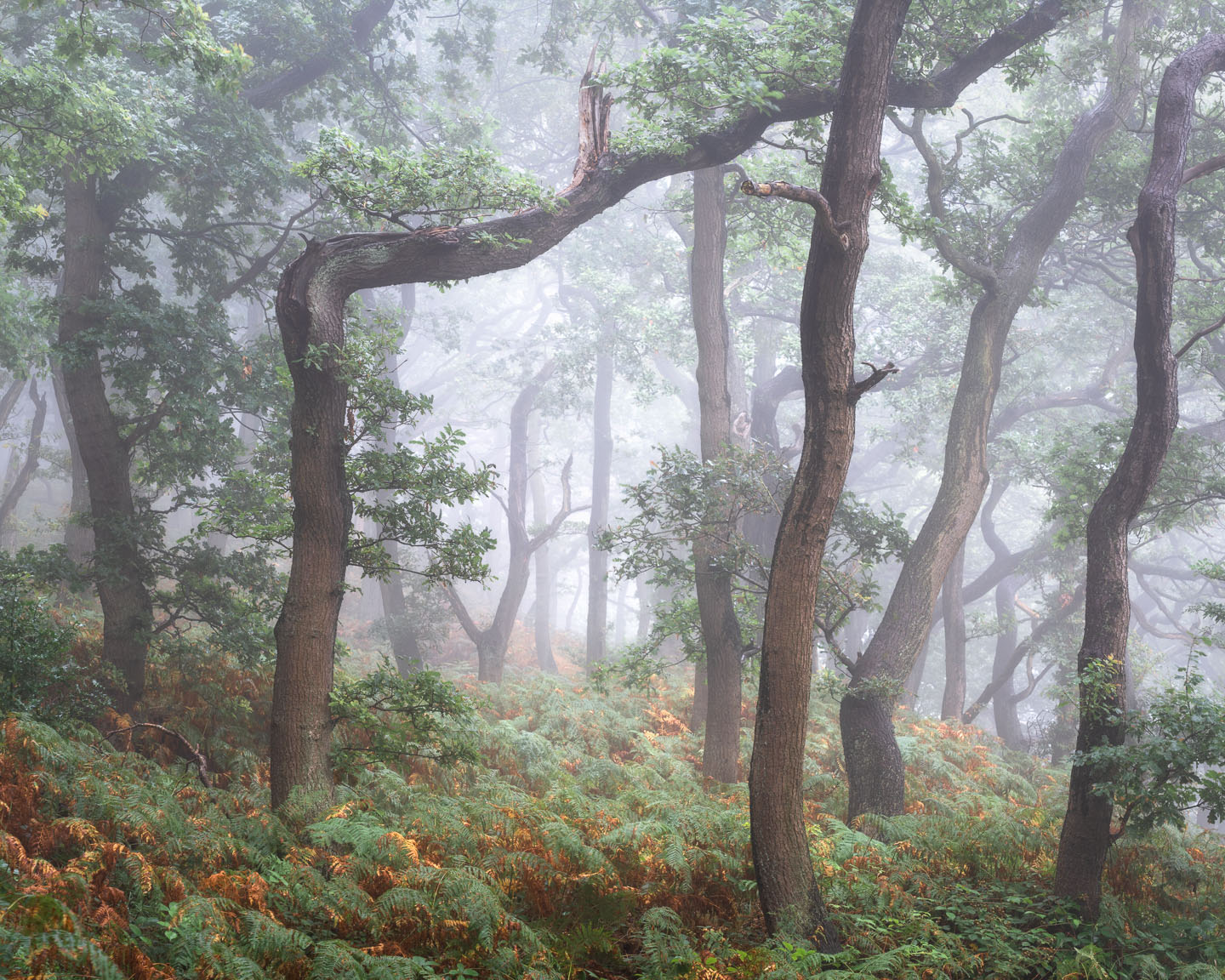
An early curiosity
My earliest memory of photography is buying a compact film camera from Argos while on holiday in Cornwall. I must have been younger than ten. I later progressed to a fully manual Pentax 35mm camera and remember watching a television series about photography presented by Chris Packham.
I began by photographing things in the garden and ordinary objects around the house before turning my attention to rallycross racing at Croft Circuit near Darlington. The subjects varied considerably, but the desire to observe and create was already present.
Photography wasn’t my only interest. Freshwater angling played an important role throughout my childhood and into my twenties. We sought quiet rivers and secluded lakes, where I photographed mist rising from still water at dawn or the colour and reflections of the evening sky.
Our attitude was always that there was more to fishing than catching fish. We valued simply being there, gradually getting to know a lake and the life within it. We avoided busy commercial fisheries and preferred places with solitude, atmosphere and elusive fish.
That romantic outlook eventually found its way into my photography.
A life spent outdoors
My upbringing encouraged an attachment to the outdoors. My grandad lived in a small village near Robin Hood’s Bay, where we played on the beach and explored the surrounding streams and woodland. I spent much of my childhood living beside a forest, building dens, climbing trees and riding bikes.
Whatever the activity, I wanted to experience nature in all its extremes—from peaceful mornings beside a perfectly still lake to mountain biking across a snow-covered moor after dark.
Later, while drifting off the coast in a sea kayak and trying to catch pollock or mackerel, the most enduring memories were not of the fish. They were of rare encounters with porpoises and, on one unforgettable occasion, a pod of dolphins.
Photography continues to provide that excuse to be outside. The images matter, but so do the encounters, discoveries and moments of gratitude that occur simply because I was there.

This outlook may seem far removed from my former life as a self-employed web developer, but I have always enjoyed the feeling of stepping out of one world and into another—from a place where time moves so quickly to a place where it seems to collect.
Injury and a return to photography
Mountain biking dominated my spare time while I studied for a degree in business and later a master’s degree in IT. It was a passion I eventually had to abandon because of a back injury.
The injury affected every aspect of my life and began a long period of physical rehabilitation. Photography gradually returned as a way to spend time outdoors, find some peace from negative thought processes and reconnect with the landscape.
I began searching for quiet, rarely visited woodlands where I could experience solitude and a childlike sense of adventure. Photography provided a purpose, but its therapeutic value was equally important. In seeking places that helped me physically and emotionally, I slowly discovered both a new world within my local countryside and a voice of my own.
Pride was the last thing on my mind during that process. Looking back, however, I feel proud to have turned my life around through photography—and thankful that I was able to do so by making images of woodlands I had discovered and grown to love.
A formative journey to Glencoe
In 2015, I made my first solo photographic trip to Glencoe. Driving for six hours was a significant undertaking after spending two and a half years avoiding prolonged periods of sitting, so reaching Scotland felt like evidence of progress in itself.
I have always been particular about finding scenes that feel personal. My relationship with photography has emotional and somewhat romantic foundations, and I wanted to return from Glencoe with something that felt like my own interpretation of the landscape.
These days, I prefer to explore unfamiliar places without researching photographs beforehand. On this occasion, however, I had been inspired by an image Tim Parkin made beneath the Three Sisters. I had no desire to replicate it; the attraction was that I had seen very few other photographs from that particular area.
My first visit on the second day of the trip was unsuccessful, but I eagerly returned after significant rainfall two days later. Everything began to fall into place.
I spent around two hours beneath an umbrella, watching showers move across the landscape and low cloud dance around the mountaintops. As the water rose, I repeatedly shifted and refined the composition until the elements finally worked together.

Compositionally, Cascade was the strongest photograph I had made at that point. More important than the image itself was the realisation of why the composition worked.
It encouraged me to think of composition as more than a means of achieving visual balance. It could communicate my experience of nature, guide the viewer through a scene and give structure to the emotional response that first made me raise the camera.
That realisation transformed my practice and made composition central to everything that followed.
Finding my voice close to home
Not long after returning from Scotland, I became more consciously aware of the choices I was making in terms of subject and mood.
During a particularly difficult day with my pain, I recognised how strongly my emotional connection with local woodland affected what I noticed and how I interpreted it. This wasn’t a matter of a bad mood encouraging me to make dark photographs. It was a deeper awareness that these places mattered to my wellbeing, and that caring about them allowed me to see more within them.
Like many photographers living near the North York Moors, I initially photographed familiar landmarks and visited places closely associated with photographers I admired—particularly Joe Cornish. That was probably an inevitable and useful stage, but I soon began to lose any sense of creative identity or personal fulfilment.
For a period, I deliberately stopped following other photographers, reading photography books and looking through magazines. In hindsight, that withdrawal gave me valuable space to learn about the landscape around me and discover which subjects I genuinely connected with.
I later encountered the work of Colin Bell and Mark Littlejohn, who were both producing wonderful photographs involving trees. Their work encouraged me to push further. I also rediscovered Joe’s photography by looking beyond the familiar landmarks and finding his quieter, more artistic and understated images.

Those influences mattered, but so did the period in which I had deliberately stepped away from them. It taught me that inspiration is most valuable when it helps us recognise something already developing within ourselves, rather than encouraging us to adopt somebody else’s view of the landscape.
Exploration before expectation
My approach to making photographs depends upon how well I know a location. It usually begins with an exploratory walk through an unfamiliar woodland, without preconceived ideas or any expectation of returning with an image.
I’m content to go with the flow and allow the time needed for the place to make sense. Sometimes I begin making photographs I like quite quickly; elsewhere, it can take many visits before I settle into the woodland and start to recognise its possibilities.
I gradually build a mental catalogue of trees and scenes that appear to hold potential. When the right season and conditions arrive, I may return with a particular photograph in mind. Some of those ideas take years to materialise, while others never happen because the woodland changes before the imagined conditions arrive.
The initial discovery remains one of the most exciting parts of the process.
In 2016, I found a dead oak enclosed within a dense plantation. It remains one of my favourite discoveries: visually striking, deeply atmospheric and slightly unnerving to experience.

The tree became the symbol used within my logo, but it also represents much of what I value in woodland photography: exploration, discovery and the excitement of gradually understanding a place.
Nothing fulfils me more than experiencing the whole process—finding a location, getting to know it intimately and appreciating all the encounters with nature that lead towards making the strongest photograph I can.
Working with limitations
Chronic pain has influenced the equipment I carry and the way I work. Unless I’m also filming, I take as little as possible: generally one camera, one versatile lens and a good tripod.
I have become comfortable with the limitations this imposes. Rather than constantly wishing for more equipment and more options, I tend to notice the subjects that the kit I’m carrying can photograph. Limitations can help to concentrate attention.
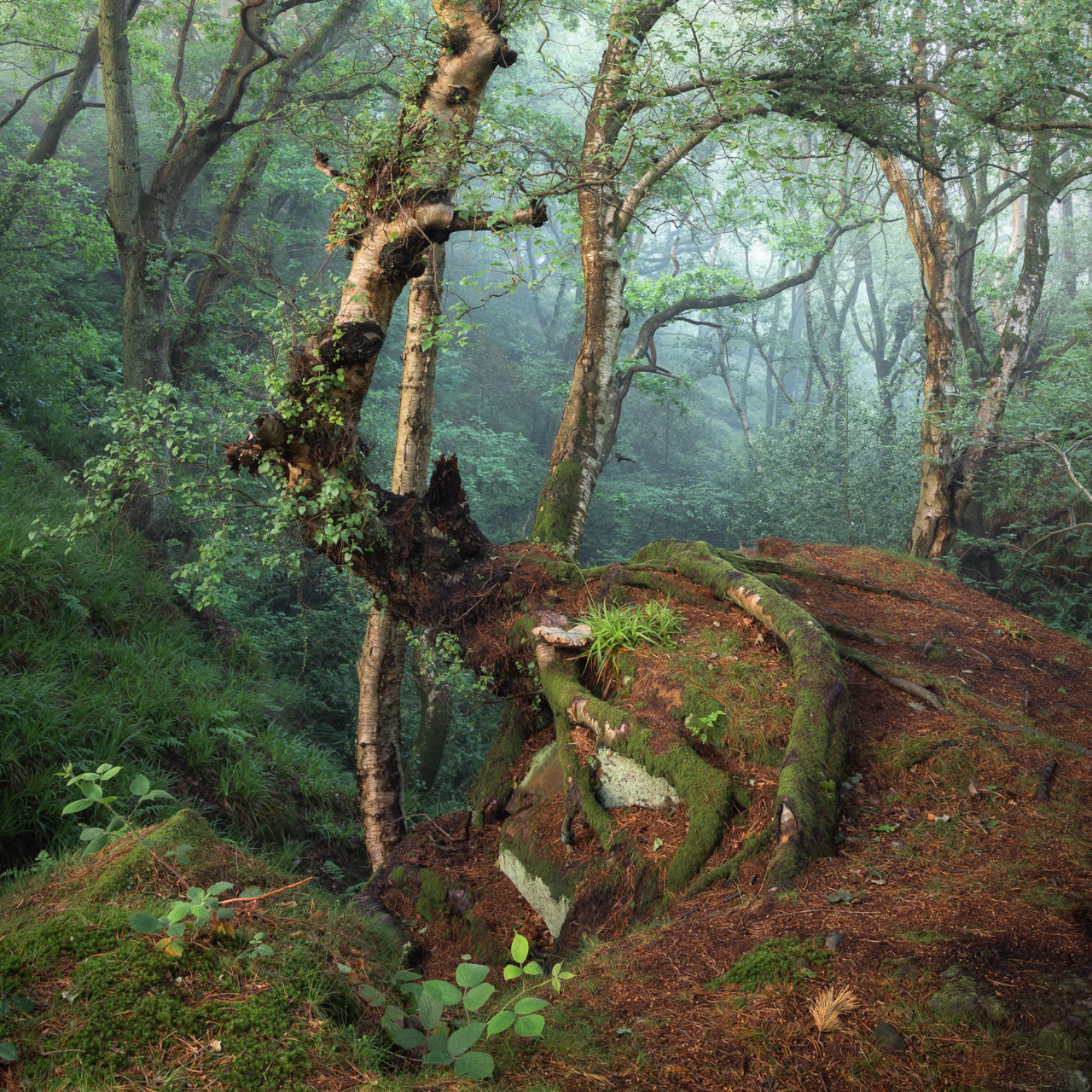
I usually begin processing an image soon after making it because I want to connect the rendition with the real experience. Recalling my original intention helps to guide those early decisions, but I then live with the photograph for a while so that I can become more objective about the result.
Each image is treated on its own merits. My approach to colour and contrast is generally soft and subtle. I’m not seeking immediate impact through processing; I want it to reinforce the feeling that prompted the photograph while remaining respectful of the experience and the reality of the place.
Printing has heightened my appreciation of light, colour and texture. Seeing an image move from the screen onto a carefully chosen matt paper feels like the completion of the process and often reveals qualities that are difficult to appreciate on a display.
Keeping the fire burning
The right frame of mind for photography isn’t always easy to define. Some of my strongest earlier work was made when I felt emotionally vulnerable or when chronic pain was taking its toll.
Perhaps the benefits of being in woodland were amplified during those periods, and my choices became more instinctive and less overthought.
A clearer mindset serves me better now. My approach has become more considered, particularly as I attempt to create increasingly complex compositions. The continuing challenge is finding a balance between meaningful time with the camera and the commercial demands surrounding it.
Allowing myself to feel relaxed and present—without thinking about photography as work—is immensely important. The business ultimately depends upon the creative fire remaining alive.

Photography is rarely my primary reason for entering a woodland. I begin by considering what I need in order to feel happy and content: quiet, movement, discovery and a sense of progression.
Creativity is often a consequence of that search for wellbeing. The distraction offered by small-scale exploration remains an important part of its therapeutic value and continues to encourage me to discover unfamiliar places.
I have no desire to abandon woodland for another photographic subject. There is still too much to understand and too much room for my interpretation of trees to evolve, mature and become more refined.

Looking back, photography has drawn together many apparently separate parts of my life: childhood curiosity, a love of quiet water and wild places, the excitement of exploration, physical adversity and the need to keep moving forward.
The camera provides a reason to look more closely, but the photographs are only part of what matters. Sometimes it is enough simply to be there, immersed in nature and receptive to whatever the experience might offer.
This essay developed from an interview originally published when I was selected as a featured photographer by On Landscape magazine.